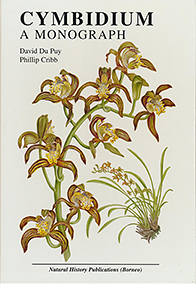
Cymbidium: A Monograph.
door/by David Du Puy & Philip Cribb.
369 pp., veel kleurenillustraties/many color illustrations en/and veel pentekeningen/pen drawings.
Natural History Publications (Borneo) Kota Kinabalu, 2007.
ISBN 983-812-125-8
Als we dit boek openslaan, zien we eerst een lijst van 38 + 1 kleurenprenten, enkel daarvan komen uit Curtis’s Botanical Magazine. Hierna volgen nog wat dankbetuigingen en een voorwoord door David Du Puy, één van de auteurs.
Het eerste hoofdstuk, ‘History’ (p. 1-6), geeft in het kort een historisch overzicht van de kennis over en de cultuur van Cymbidium.
Het hoofdstuk, ‘Morphology’ (p. 7-10), informeert over de morfologie van de Cymbidium-bloemen en –planten en de protocorm structuur.
Het derde, met microscopische foto’s geïllustreerde hoofdstuk, ‘Seed Morphology’ (p. 11-14), gaat exclusief over de morfologie van de Cymbidium-zaden.
In het vierde hoofdstuk, ‘Anatomy’ (p. 15-28), lezen we over de anatomie van de bladeren, de pseudobulben de wortels en de ageotropische wortels. Dit hoofdstuk is met tekeningen, microscopische foto’s en tabellen geïllustreerd.
In het hoofdstuk, ‘Cytology’ (p. 29-30), worden we geïnformeerd over de chromosomen, de ‘meiosis en de sporad development’ en de karyomorphology.
Het zesde hoofdstuk, ‘Pollination Biology and Floral Fragrances’ (p. 31-36), beschrijft de pollinisatie van Cymbidium-soorten en geeft enkel lijnen over de geuren bij sommige soorten. Het pollinisatie-item is goed geïllustreerd.
Hoofstuk 7, ‘Cultivation’ (p. 37-40), informeert over de cultuur en kweekomstandigheden, ziekten en plagen, verpotten en potmengsels, watergiften en bemesting.
In hoofstuk 8, ‘Hybridisation and breeding’ (p. 41-50), maken we kennis met de evolutie van de hybridisatie van Cymbidium.
Hoofdstuk 9, ‘Other uses’ (p. 51-52), lezen,we over het gebruik van Cymbidium-planten in de geneeskunde, als voedsel of als bv. het maken van lijm.
In hoofdstuk 10, ‘Distribution an biogeography’ (p. 53-56), vinden we informative over de Verspreiding van de Cymbidium-soorten iin Zuid-Oost Azië en Australië.
Hoofdstuk 11, ‘Phylogeny’ (p. 57-63) behandelt de evolutionaire relaties van de Cymbidium-soorten.
Hoofdstuk 12, ‘Conservation’ (p. 65-66) toont aan dat de Cymbidium-ssorten, vooral de pas ontdekte soorten, op eenzelfde niveau met uitsterven bedreigd zijn als veel zogenaamde venusschoentjes (Cypripedium, Phragmipedium, Paphiopedilum, Selenipedium).
Hoofdstuk 13, ‘Classification’ (p. 67-71), behandelt de classificatie (taxonomisch en infragenerisch) van Cymbidium in twee sub-hoofdstukken: ‘The taxonomic position of Cymbidium Sw. within the Orchidaceae’ and ‘The infrageneric classification of Cymbidium Sw.’.
Hoofdstul 14, ‘Taxonomy’ (p. 73-330), bespreekt alle op datum van publicatie gekende Cymbidium-soorten: sectioneel met 11 secties en de soorten binnen elke sectie, een sleutel tot de secties en tot de soorten. Daarop volgt de beschrijving van de soorten (introductie, synoniemen, volledige beschrijving, verspreiding, habitat info en de conservation-status). Dit alles is geïllustreerd met zeer goede foto’s, verspreidingskaarten en mooie pentekeningen die zeer nuttig zijn bij de determinatie van de soorten.
Het boek eindigt met een ‘Addendum’ (p. 333-337) waarin gesteld wordt dat tussen de duizeende planten die elk jaar in de natuur verzameld worden, vooral in China, planten gevonden worden die niet passen in de beschrijving van gekende soorten. Daarop volgen een aantal interessante en nuttige pagina’s ‘Bibliography an further reading’ (p. 338-350); ‘Cymbidium specimens examined’ (p. 351-359); a ‘Glossary’ (p. 360-363) and an ‘Index of scientific names’ (p. 364-369).
Conclusie.
We hebben hier een zeer mooi uitgegeven orchideeënboek met relevante en zeer goede illustraties, foto’s en tekeningen naast de teksten. Dit boek hoort thuis in de bibliotheek van elke verzamelaar van orchideeënboeken en het is uiteraard een ‘must have’ voor elke Cymbidium-kweker.
top
This book opens with a list of 38 + 1 color plates, some of them f.i. from Curtis’s Botanical Magazine. Then follow ‘Acknowledgements’ and a ‘Preface’ by David Du Puy, one of the authors.
The first chapter ‘History’ (p. 1-6) gives a short impression of the history of the knowledge and culture of Cymbidium.
The Chapter ‘Morphology’ (p. 7-10) informs about the vegetative morphology, floral morphology and protocorm structure of Cymbidium.
The third chapter is exclusively about ‘Seed Morphology’ (p. 11-14) and is illustrated with microscopic photos.
In the fourth chapter ‘Anatomy’ (p. 15-28) we are informed about the anatomy of the leaf, the variation in the anatomy and surface morphology of Cymbidium-leaves, the anatomy in related genera, the pseudobulb anatomy, the root anatomy and the ageotropic roots. This chapter is illustrated with drawings, microscopic photos and tables.
The chapter ‘Cytology’ (p. 29-30) informs about chromosome numbers, meiosis and sporad development and karyomorphology.
Chapter 6 ‘Pollination Biology and Floral Fragrances’ (p. 31-36) describes pollination aspects and adds some lines about the floral fragrances of Cymbidium-species. The pollination item is well illustrated.
Chapter 7 ‘Cultivation’ (p. 37-40) informs about cultivation and growing condition, pests and diseases, repotting and composts, watering and feeding.
Chapter 8 ‘Hybridisation and breeding’ (p. 41-50) shows the evolution of Cymbidium-hybridisation.
In chapter 9 ‘Other uses’ (p. 51-52) we read about uses of Cymbidium-plants in medicine, as food or f.i. as base to produce glue.
In chapter 10 (p. 53-56)‘Distribution an biogeography’ we find information about the distribution of the Cymbisium-species in South-East Asia and Australia.
Chapter 11 ‘Phylogeny’ (p. 57-63) is about the evolutionary relations between Cymbidium-species.
Chapter 12 ‘Conservation’ (p. 65-66) shows that even Cymbidium-species, especialy newly described ones, are at the same threat level as many slipper orchids.
In chapter 13 ‘Classification’ (p. 67-71) we earn about the classification of Cymbidium in 2 subchapters: ‘The taxonomic position of Cymbidium Sw. within the Orchidaceae’ and ‘The infrageneric classification of Cymbidium Sw.’.
Chapter 14 ‘Taxonomy’ (p. 73-330) presents all known Cymbidium-species at date of publication: Sectional treatment of Cymbidium with 11 sections and the species within each section; a key to the sections; an artificial key to the Cymbidium-species; description of the species with an introduction of the species, some synonyms, a complete description, distribution in nature and habitat info and conservation status as well. Very good photos, distribution maps en nice pen drawings beside the descriptions of the species are very useful for the determination.
The book ends with an ‘Addendum’ (p. 333-337) wherein is stated that to the present days amongst thousands of wild collected plants each year, particularly in China, plants are found that do not fit into the descriptions of the known species; a very interesting and useful ‘Bibliography an further reading’ (p. 338-350); ‘Cymbidium specimens examined’ (p. 351-359); a ‘Glossary’ (p. 360-363) and an ‘Index of scientific names’ (p. 364-369).
Conclusion.
This book is a very well edited orchid book with relevant and very good illustrations, photos and drawings, beside the texts. It has his place in every library of orchid book collectors and of course for sure it is a necessity for all Cymbidium-growers.
top